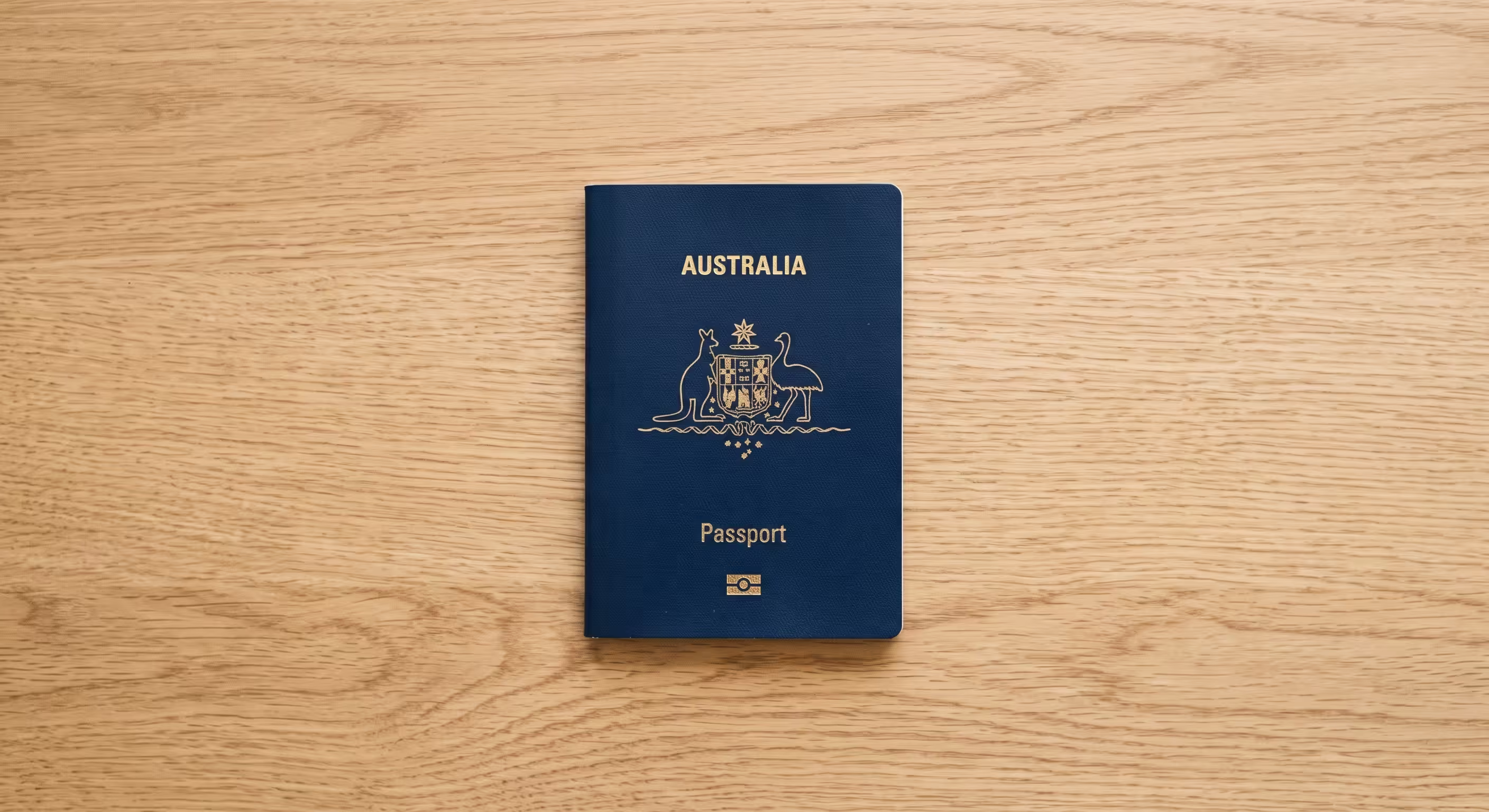
If you’re on a permanent visa, Australian citizenship is the final step. It unlocks things permanent residency can’t, including an Australian passport, the right to vote and the freedom to re-enter Australia without a five-year travel facility expiry hanging over you.
But the Australian citizenship requirements can feel opaque, especially if it’s been years since you first lodged a visa application and you’re not sure where you stand.
This guide sets out everything you need to know: the eligibility criteria, how the citizenship test works, what changes when you become a citizen and the step-by-step conferral process.
Key takeaways:
- To be eligible for Australian citizenship by conferral, you must have lived in Australia for four years on a valid visa, with at least one year as a permanent resident.
- You can’t have been absent from Australia for more than 12 months in total across those four years, and no more than 90 days in the 12 months immediately before applying for citizenship.
- You’ll need to pass the citizenship test with a score of at least 75%.
- The application fee is currently $575, with 90% of applications processed within seven months.
- Australia recognises dual citizenship, but many countries don’t. Check your home country’s rules before applying.
What Is Australian Citizenship by Conferral?
Australian citizenship by conferral is the process whereby a permanent resident formally becomes an Australian citizen. It’s different from citizenship acquired automatically at birth or inherited through a parent. Conferral requires an application, a citizenship test and a ceremony.
In 2024–25, 165,193 people became Australian citizens by conferral. It was the highest number in recent years, drawn from over 190 different nationalities.
Since Australian citizenship was introduced in 1949, more than 6.2 million people have made the pledge. Most of them spent years working their way through the visa system to reach that moment.
There are three pathways to Australian citizenship:
- By birth (people born in Australia to at least one parent who is an Australian citizen or permanent resident)
- By descent (people born outside Australia on or after 26 January 1949 to a parent who was an Australian citizen at the time of birth)
- By conferral (the standard route for migrants who have lived in Australia on a permanent visa and met the residence and other eligibility requirements).
For most migrants, conferral is the only pathway available. Whatever visa brought you to Australia (a partner visa, an employer-sponsored visa, a skilled independent visa or any other permanent stream), the conferral process is the same. The key variable is whether you’ve met the Australian citizenship requirements set out by Home Affairs.
Citizenship by conferral is not the same as permanent residency. PR is the status you hold once you’ve been granted a permanent visa.
You can live in Australia indefinitely on a permanent visa, but you can’t vote, hold an Australian passport or stand for parliament. Citizenship gives you the full range of legal rights reserved for citizens of Australia.
Who Qualifies: Australian Citizenship Requirements in Full
Citizenship eligibility in Australia is determined by Home Affairs against a defined set of criteria. To apply for citizenship by conferral, you must satisfy all of the following requirements at the time of application.
| Requirement |
What you need to show |
| Residence (general) |
4 years on a valid Australian visa immediately before applying |
| Permanent residency |
At least 1 year as a permanent resident immediately before applying (within that 4-year period) |
| Travel absences |
No more than 12 months away in the past 4 years and no more than 90 days away in the past 12 months |
| Character |
No serious criminal history (uphold Australian laws and the citizenship pledge) |
| Language |
Basic English, a requirement satisfied by passing the citizenship test |
| Knowledge |
Pass the Australian citizenship test with a score of at least 75% |
| Close and continuing link |
Family ties (citizen partner or child), employment or property in Australia |
| Application fee |
$575 currently |
Residence requirement
You must have been lawfully in Australia for at least four years immediately before the date of your application. At least one of those four years must have been spent as a permanent resident (or eligible New Zealand citizen)ne year as a permanent resident needs to be in the 12 months immediately prior to applying for citizenship.
You don’t need to have been on a single visa for the entire period. The time accumulates across different valid visas.
Absence rules
Time outside Australia can disqualify your application, even if your residence period looks correct on paper. The rules are strict:
- No more than 12 months in total outside Australia in the four-year period
- No more than 90 days in total outside Australia in the last 12 months of that period.
Matilda Tip: Before lodging your application, work backwards through your travel history to check your absences carefully. Many applicants are surprised to find they’ve gone just over the 90-day limit after a long overseas trip. The day you depart and the day you arrive back both count as days in Australia. If you’re close to the limit, it might be worth waiting a few more months before applying for citizenship.
Character requirement
You must be of good character in the view of Home Affairs. This means no serious criminal convictions in Australia or overseas.
Home Affairs will ask for police certificates from every country where you’ve lived for 12 months or more in the past 10 years, as well as carrying out an Australian National Police Check.
Language and knowledge requirements
You must have a basic knowledge of English. The citizenship test itself satisfies this requirement.
You also need to demonstrate an understanding of what it means to be an Australian citizen by sitting and passing the citizenship test.
Close and continuing link
You’ll need to show meaningful ties to Australia. This can be demonstrated through a partner or child who is an Australian citizen or permanent resident, ongoing employment or property ownership in Australia.
For most long-term permanent residents, this requirement is straightforward to satisfy.
The Australian Citizenship Test: What to Expect
The Australian citizenship test is a multiple choice test designed to assess your understanding of Australia’s values, history, government and the rights and responsibilities of citizenship. If you don’t pass, you can apply to resit the test as many times as you like.
The test includes 20 questions, drawn from the official resource book "Our Common Bond". You need to answer at least 15 questions correctly (75%) to pass, and you must answer correctly all questions related to the pledges, the responsibilities and privileges of citizenship, and Australia’s democratic beliefs.
The test is computer-based and completed at a Home Affairs office.
Topics covered include:
- Australia’s history, geography and system of government
- The values of Australian democracy
- The responsibilities and privileges of citizenship
- The pledge of commitment.
The following people are exempt from the citizenship test:
- Applicants aged 60 or over
- People with a permanent hearing, speech or sight impairment
- Children aged 15 or under who are included in a parent’s application.
Matilda Tip: Read the full "Our Common Bond" resource book rather than relying on study apps or third-party summaries. The questions are taken directly from the official text. Most applicants with a working knowledge of Australia find the test straightforward after one careful read-through. Give yourself at least a week of preparation time.
The "Our Common Bond" study guide contains every testable question and its correct answer.
Australian Citizenship vs Permanent Residency: What Actually Changes?
Many long-term permanent residents ask whether citizenship is worth the effort, especially if they already have Medicare, work rights and the ability to sponsor family. The answer is that the practical differences are real, and for most people who plan to stay in Australia permanently, citizenship is the right move.
Here’s how the two statuses compare:
| Right or entitlement |
Permanent resident |
Australian citizen |
| Live, work and study indefinitely |
✓ |
✓ |
| Medicare and welfare access |
✓ |
✓ |
| Sponsor family members for PR |
✓ |
✓ |
| Leave and re-enter freely (travel facility active) |
✓ (5-year facility) |
✓ (no expiry) |
| Australian passport |
✗ |
✓ |
| Vote in federal elections |
✗ |
✓ |
| Stand for parliament |
✗ |
✓ |
| Consular assistance overseas |
Limited |
✓ |
| Australian citizenship certificate |
✗ |
✓ |
The most significant practical differences come down to travel and security. An Australian citizen can re-enter Australia at any time, without a travel facility, forever.
A permanent resident’s right to re-enter Australia expires after five years, and renewing it requires either applying for a Resident Return Visa or demonstrating substantial ties to Australia. If you’re a frequent traveller, or expect to spend extended time overseas, citizenship offers a stability that PR doesn’t.
Step-by-Step: How to Apply for Australian Citizenship by Conferral
Australian citizenship requirements are assessed across five stages. The process is managed through the Home Affairs online system (ImmiAccount), with the exception of the test appointment, which is held in person.
Stage 1: Check eligibility
Before applying for citizenship, confirm that you meet all the criteria above (particularly the four-year residence requirement, the 90-day absence rule and the character requirement).
The date of application is critical: the four-year period is calculated to the day you submit your application, not the day you start preparing it.
Matilda Tip: One of the most common reasons citizenship applications are delayed is an incomplete or unclear travel history. Request your departure and arrival records from the Department, and map every overseas trip against the 12-month and 90-day absence thresholds. A decision-ready application is one where this work is done before lodgement, not after Home Affairs raises a query.
Stage 2: Gather documents and lodge your application
Before you apply, you’ll need to provide:
- Identity documents: At least three documents showing your full birth name, date of birth, gender, photograph, signature and current residential address
- Character documents: Police clearance certificates from Australia (the Department will request these on your behalf) and, in practice, every country where you’ve spent 90 days or more since you acquired PR
- Supporting documents: Evidence of any exemptions or concessions you’re applying for (for example, a medical certificate if you’re applying for a test exemption).
The application fee of $575 is paid at the time of lodgement. Additional applicants included in the same application (such as children) attract separate charges. There is no cost for a child 15 years or under applying on the same form as the primary adult applicant.
Stage 3: Citizenship test appointment
If Home Affairs determines you’re eligible after reviewing your application, they’ll invite you to attend a citizenship appointment. At this appointment, you’ll sit the 20-question citizenship test at a Home Affairs office. Results are provided on the day. If you don’t pass, you can apply to resit the test.
Stage 4: Decision
After passing the citizenship test, Home Affairs will assess your full application and make a decision. If approved, you’ll receive notification to attend a citizenship ceremony.
Stage 5: Citizenship ceremony
The citizenship ceremony is where you make the Australian Citizenship Pledge and officially become an Australian citizen. Ceremonies are organised by your local council and held regularly. 90% of approved applicants have the opportunity to attend a ceremony within six months of approval.
You have two options for the pledge:
- Pledge 1 (with religious affirmation): Includes the phrase "under God"
- Pledge 2 (secular): The same pledge without a religious reference.
Overall, 90% of citizenship applications are processed within seven months. The timeframe is generally faster than most permanent visa applications, which makes the citizenship stage one of the less stressful parts of the migration journey.
Special Circumstances Worth Knowing
Children born in Australia to non-citizens
A child born in Australia does not automatically receive citizenship unless at least one parent is an Australian citizen or permanent resident at the time of birth. If neither parent holds citizenship or PR, the child will generally take the visa status of the parents.
If at least one parent is an Australian permanent resident (or a Special Category subclass 444 visa holder, on or after 1 July 2022), the child may be eligible for citizenship. Home Affairs recommends applying online for evidence of Australian citizenship to formally document the child’s status.
Matilda Tip: Children aged 15 or younger can be included on a parent's citizenship application, which avoids the need for a separate lodgement and test. If your child was born in Australia, seek advice on whether they automatically acquired citizenship at birth before including them in your application. The answer affects the paperwork you'll need to prepare.
Dual citizenship and Australia
Australia recognises dual citizenship, which means you can hold an Australian passport and a foreign passport simultaneously. You don’t have to renounce your existing citizenship to become Australian.
However, many countries don’t recognise dual citizenship. Notable examples include Japan, India, China, Indonesia and Singapore, countries from which a significant proportion of Australian migrants originate.
If your home country’s laws require you to renounce your previous citizenship on acquiring a new one, applying for Australian citizenship may result in the automatic loss of your original nationality. Check your home country’s rules carefully before lodging your application.
Eligible New Zealand citizens
New Zealand citizens holding a Special Category (subclass 444) visa have a distinct pathway. They can apply for citizenship by conferral if they have held the subclass 444 visa and have been living in Australia as a permanent resident or Australian citizen for the past five years (with 12 months of that period in the last two years as PR or citizen).
The rules changed in 2023 to make NZ citizens more easily eligible, and New Zealanders represented the single largest source of new citizens in 2024–25, with 33,103 conferrals.
Frequently Asked Questions
How long do I need to live in Australia before I can apply for citizenship?
You must have been lawfully living in Australia for four years immediately before applying, with at least one of those years as a permanent resident. The four-year period counts any valid Australian visa (including temporary visas ), as long as you were lawfully in the country.
You also can’t have been absent from Australia for more than 12 months in that four-year period, or more than 90 days in the last 12 months.
What happens if I fail the citizenship test?
If you don’t achieve the required 75% score, you can apply to resit the test. There is no limit on the number of attempts, though Home Affairs will schedule a new appointment for each resit.
If you’re concerned about the test, the "Our Common Bond" study guide contains every testable question and its correct answer.
Does Australia allow dual citizenship?
Yes. Australia has recognised dual citizenship since 2002. Becoming an Australian citizen does not require you to give up your existing nationality.
However, your home country may have different rules. Some countries automatically strip citizenship when you acquire another. Check your country’s laws before applying.
How much does Australian citizenship cost?
The application charge is $575 per adult applicant as at 1 July 2024. Children aged under 18 who are not the primary applicant are charged at a lower rate.
These are government fees paid directly to Home Affairs. If you’re working with a migration agent or lawyer, their professional fees are separate.
Can children be included in my citizenship application?
Yes. Children aged 15 or under can be included in a parent’s application. They are generally exempt from the citizenship test. Children who are 16 or 17 need to lodge their own separate application.
Children who were born in Australia to a parent who was already a permanent resident at the time of birth may already be Australian citizens. Seek advice before including them in your application.
How long does citizenship processing take?
According to Home Affairs, 90% of applications are processed within seven months. Once approved, 90% of applicants attend a ceremony within six months of their approval. Individual times vary depending on the completeness of your application and your local council’s ceremony schedule.
I missed out on meeting the residence requirement. Can I still apply?
Not unless one of these exemptions or special circumstances applies to you. The four-year residence requirement and the absence limits are fixed eligibility criteria. If you don’t currently meet them, you need to wait until you do.
If you’re close to meeting the requirement, a consultation with a migration professional like Matilda can help you confirm your exact eligibility date and plan your application accordingly.
Ready to Take the Final Step?
Australian citizenship is the endpoint of a migration journey that, for most people, has taken years and no small amount of effort. The citizenship eligibility requirements are specific but achievable. The four-year residence period, the absence rules, the test and the character check are all clear hurdles with clear solutions.
If you’re approaching eligibility and want to make sure your application is decision-ready the first time, the Matilda team is here to help. Our lawyer-credentialled team has helped clients at every stage of the migration process, from first visa application through to the citizenship ceremony.
For visa holders approaching citizenship eligibility, book a consultation with Matilda to confirm your eligibility and prepare a complete application.
For employers supporting staff on the path to PR and citizenship, talk to us about ongoing compliance and pathway planning.
If you’re on a permanent visa, Australian citizenship is the final step. It unlocks things permanent residency can’t, including an Australian passport, the right to vote and the freedom to re-enter Australia without a five-year travel facility expiry hanging over you.
But the Australian citizenship requirements can feel opaque, especially if it’s been years since you first lodged a visa application and you’re not sure where you stand.
This guide sets out everything you need to know: the eligibility criteria, how the citizenship test works, what changes when you become a citizen and the step-by-step conferral process.
Key takeaways:
- To be eligible for Australian citizenship by conferral, you must have lived in Australia for four years on a valid visa, with at least one year as a permanent resident.
- You can’t have been absent from Australia for more than 12 months in total across those four years, and no more than 90 days in the 12 months immediately before applying for citizenship.
- You’ll need to pass the citizenship test with a score of at least 75%.
- The application fee is currently $575, with 90% of applications processed within seven months.
- Australia recognises dual citizenship, but many countries don’t. Check your home country’s rules before applying.
What Is Australian Citizenship by Conferral?
Australian citizenship by conferral is the process whereby a permanent resident formally becomes an Australian citizen. It’s different from citizenship acquired automatically at birth or inherited through a parent. Conferral requires an application, a citizenship test and a ceremony.
In 2024–25, 165,193 people became Australian citizens by conferral. It was the highest number in recent years, drawn from over 190 different nationalities.
Since Australian citizenship was introduced in 1949, more than 6.2 million people have made the pledge. Most of them spent years working their way through the visa system to reach that moment.
There are three pathways to Australian citizenship:
- By birth (people born in Australia to at least one parent who is an Australian citizen or permanent resident)
- By descent (people born outside Australia on or after 26 January 1949 to a parent who was an Australian citizen at the time of birth)
- By conferral (the standard route for migrants who have lived in Australia on a permanent visa and met the residence and other eligibility requirements).
For most migrants, conferral is the only pathway available. Whatever visa brought you to Australia (a partner visa, an employer-sponsored visa, a skilled independent visa or any other permanent stream), the conferral process is the same. The key variable is whether you’ve met the Australian citizenship requirements set out by Home Affairs.
Citizenship by conferral is not the same as permanent residency. PR is the status you hold once you’ve been granted a permanent visa.
You can live in Australia indefinitely on a permanent visa, but you can’t vote, hold an Australian passport or stand for parliament. Citizenship gives you the full range of legal rights reserved for citizens of Australia.
Who Qualifies: Australian Citizenship Requirements in Full
Citizenship eligibility in Australia is determined by Home Affairs against a defined set of criteria. To apply for citizenship by conferral, you must satisfy all of the following requirements at the time of application.
| Requirement |
What you need to show |
| Residence (general) |
4 years on a valid Australian visa immediately before applying |
| Permanent residency |
At least 1 year as a permanent resident immediately before applying (within that 4-year period) |
| Travel absences |
No more than 12 months away in the past 4 years and no more than 90 days away in the past 12 months |
| Character |
No serious criminal history (uphold Australian laws and the citizenship pledge) |
| Language |
Basic English, a requirement satisfied by passing the citizenship test |
| Knowledge |
Pass the Australian citizenship test with a score of at least 75% |
| Close and continuing link |
Family ties (citizen partner or child), employment or property in Australia |
| Application fee |
$575 currently |
Residence requirement
You must have been lawfully in Australia for at least four years immediately before the date of your application. At least one of those four years must have been spent as a permanent resident (or eligible New Zealand citizen)ne year as a permanent resident needs to be in the 12 months immediately prior to applying for citizenship.
You don’t need to have been on a single visa for the entire period. The time accumulates across different valid visas.
Absence rules
Time outside Australia can disqualify your application, even if your residence period looks correct on paper. The rules are strict:
- No more than 12 months in total outside Australia in the four-year period
- No more than 90 days in total outside Australia in the last 12 months of that period.
Matilda Tip: Before lodging your application, work backwards through your travel history to check your absences carefully. Many applicants are surprised to find they’ve gone just over the 90-day limit after a long overseas trip. The day you depart and the day you arrive back both count as days in Australia. If you’re close to the limit, it might be worth waiting a few more months before applying for citizenship.
Character requirement
You must be of good character in the view of Home Affairs. This means no serious criminal convictions in Australia or overseas.
Home Affairs will ask for police certificates from every country where you’ve lived for 12 months or more in the past 10 years, as well as carrying out an Australian National Police Check.
Language and knowledge requirements
You must have a basic knowledge of English. The citizenship test itself satisfies this requirement.
You also need to demonstrate an understanding of what it means to be an Australian citizen by sitting and passing the citizenship test.
Close and continuing link
You’ll need to show meaningful ties to Australia. This can be demonstrated through a partner or child who is an Australian citizen or permanent resident, ongoing employment or property ownership in Australia.
For most long-term permanent residents, this requirement is straightforward to satisfy.
The Australian Citizenship Test: What to Expect
The Australian citizenship test is a multiple choice test designed to assess your understanding of Australia’s values, history, government and the rights and responsibilities of citizenship. If you don’t pass, you can apply to resit the test as many times as you like.
The test includes 20 questions, drawn from the official resource book "Our Common Bond". You need to answer at least 15 questions correctly (75%) to pass, and you must answer correctly all questions related to the pledges, the responsibilities and privileges of citizenship, and Australia’s democratic beliefs.
The test is computer-based and completed at a Home Affairs office.
Topics covered include:
- Australia’s history, geography and system of government
- The values of Australian democracy
- The responsibilities and privileges of citizenship
- The pledge of commitment.
The following people are exempt from the citizenship test:
- Applicants aged 60 or over
- People with a permanent hearing, speech or sight impairment
- Children aged 15 or under who are included in a parent’s application.
Matilda Tip: Read the full "Our Common Bond" resource book rather than relying on study apps or third-party summaries. The questions are taken directly from the official text. Most applicants with a working knowledge of Australia find the test straightforward after one careful read-through. Give yourself at least a week of preparation time.
The "Our Common Bond" study guide contains every testable question and its correct answer.
Australian Citizenship vs Permanent Residency: What Actually Changes?
Many long-term permanent residents ask whether citizenship is worth the effort, especially if they already have Medicare, work rights and the ability to sponsor family. The answer is that the practical differences are real, and for most people who plan to stay in Australia permanently, citizenship is the right move.
Here’s how the two statuses compare:
| Right or entitlement |
Permanent resident |
Australian citizen |
| Live, work and study indefinitely |
✓ |
✓ |
| Medicare and welfare access |
✓ |
✓ |
| Sponsor family members for PR |
✓ |
✓ |
| Leave and re-enter freely (travel facility active) |
✓ (5-year facility) |
✓ (no expiry) |
| Australian passport |
✗ |
✓ |
| Vote in federal elections |
✗ |
✓ |
| Stand for parliament |
✗ |
✓ |
| Consular assistance overseas |
Limited |
✓ |
| Australian citizenship certificate |
✗ |
✓ |
The most significant practical differences come down to travel and security. An Australian citizen can re-enter Australia at any time, without a travel facility, forever.
A permanent resident’s right to re-enter Australia expires after five years, and renewing it requires either applying for a Resident Return Visa or demonstrating substantial ties to Australia. If you’re a frequent traveller, or expect to spend extended time overseas, citizenship offers a stability that PR doesn’t.
Step-by-Step: How to Apply for Australian Citizenship by Conferral
Australian citizenship requirements are assessed across five stages. The process is managed through the Home Affairs online system (ImmiAccount), with the exception of the test appointment, which is held in person.
Stage 1: Check eligibility
Before applying for citizenship, confirm that you meet all the criteria above (particularly the four-year residence requirement, the 90-day absence rule and the character requirement).
The date of application is critical: the four-year period is calculated to the day you submit your application, not the day you start preparing it.
Matilda Tip: One of the most common reasons citizenship applications are delayed is an incomplete or unclear travel history. Request your departure and arrival records from the Department, and map every overseas trip against the 12-month and 90-day absence thresholds. A decision-ready application is one where this work is done before lodgement, not after Home Affairs raises a query.
Stage 2: Gather documents and lodge your application
Before you apply, you’ll need to provide:
- Identity documents: At least three documents showing your full birth name, date of birth, gender, photograph, signature and current residential address
- Character documents: Police clearance certificates from Australia (the Department will request these on your behalf) and, in practice, every country where you’ve spent 90 days or more since you acquired PR
- Supporting documents: Evidence of any exemptions or concessions you’re applying for (for example, a medical certificate if you’re applying for a test exemption).
The application fee of $575 is paid at the time of lodgement. Additional applicants included in the same application (such as children) attract separate charges. There is no cost for a child 15 years or under applying on the same form as the primary adult applicant.
Stage 3: Citizenship test appointment
If Home Affairs determines you’re eligible after reviewing your application, they’ll invite you to attend a citizenship appointment. At this appointment, you’ll sit the 20-question citizenship test at a Home Affairs office. Results are provided on the day. If you don’t pass, you can apply to resit the test.
Stage 4: Decision
After passing the citizenship test, Home Affairs will assess your full application and make a decision. If approved, you’ll receive notification to attend a citizenship ceremony.
Stage 5: Citizenship ceremony
The citizenship ceremony is where you make the Australian Citizenship Pledge and officially become an Australian citizen. Ceremonies are organised by your local council and held regularly. 90% of approved applicants have the opportunity to attend a ceremony within six months of approval.
You have two options for the pledge:
- Pledge 1 (with religious affirmation): Includes the phrase "under God"
- Pledge 2 (secular): The same pledge without a religious reference.
Overall, 90% of citizenship applications are processed within seven months. The timeframe is generally faster than most permanent visa applications, which makes the citizenship stage one of the less stressful parts of the migration journey.
Special Circumstances Worth Knowing
Children born in Australia to non-citizens
A child born in Australia does not automatically receive citizenship unless at least one parent is an Australian citizen or permanent resident at the time of birth. If neither parent holds citizenship or PR, the child will generally take the visa status of the parents.
If at least one parent is an Australian permanent resident (or a Special Category subclass 444 visa holder, on or after 1 July 2022), the child may be eligible for citizenship. Home Affairs recommends applying online for evidence of Australian citizenship to formally document the child’s status.
Matilda Tip: Children aged 15 or younger can be included on a parent's citizenship application, which avoids the need for a separate lodgement and test. If your child was born in Australia, seek advice on whether they automatically acquired citizenship at birth before including them in your application. The answer affects the paperwork you'll need to prepare.
Dual citizenship and Australia
Australia recognises dual citizenship, which means you can hold an Australian passport and a foreign passport simultaneously. You don’t have to renounce your existing citizenship to become Australian.
However, many countries don’t recognise dual citizenship. Notable examples include Japan, India, China, Indonesia and Singapore, countries from which a significant proportion of Australian migrants originate.
If your home country’s laws require you to renounce your previous citizenship on acquiring a new one, applying for Australian citizenship may result in the automatic loss of your original nationality. Check your home country’s rules carefully before lodging your application.
Eligible New Zealand citizens
New Zealand citizens holding a Special Category (subclass 444) visa have a distinct pathway. They can apply for citizenship by conferral if they have held the subclass 444 visa and have been living in Australia as a permanent resident or Australian citizen for the past five years (with 12 months of that period in the last two years as PR or citizen).
The rules changed in 2023 to make NZ citizens more easily eligible, and New Zealanders represented the single largest source of new citizens in 2024–25, with 33,103 conferrals.
Frequently Asked Questions
How long do I need to live in Australia before I can apply for citizenship?
You must have been lawfully living in Australia for four years immediately before applying, with at least one of those years as a permanent resident. The four-year period counts any valid Australian visa (including temporary visas ), as long as you were lawfully in the country.
You also can’t have been absent from Australia for more than 12 months in that four-year period, or more than 90 days in the last 12 months.
What happens if I fail the citizenship test?
If you don’t achieve the required 75% score, you can apply to resit the test. There is no limit on the number of attempts, though Home Affairs will schedule a new appointment for each resit.
If you’re concerned about the test, the "Our Common Bond" study guide contains every testable question and its correct answer.
Does Australia allow dual citizenship?
Yes. Australia has recognised dual citizenship since 2002. Becoming an Australian citizen does not require you to give up your existing nationality.
However, your home country may have different rules. Some countries automatically strip citizenship when you acquire another. Check your country’s laws before applying.
How much does Australian citizenship cost?
The application charge is $575 per adult applicant as at 1 July 2024. Children aged under 18 who are not the primary applicant are charged at a lower rate.
These are government fees paid directly to Home Affairs. If you’re working with a migration agent or lawyer, their professional fees are separate.
Can children be included in my citizenship application?
Yes. Children aged 15 or under can be included in a parent’s application. They are generally exempt from the citizenship test. Children who are 16 or 17 need to lodge their own separate application.
Children who were born in Australia to a parent who was already a permanent resident at the time of birth may already be Australian citizens. Seek advice before including them in your application.
How long does citizenship processing take?
According to Home Affairs, 90% of applications are processed within seven months. Once approved, 90% of applicants attend a ceremony within six months of their approval. Individual times vary depending on the completeness of your application and your local council’s ceremony schedule.
I missed out on meeting the residence requirement. Can I still apply?
Not unless one of these exemptions or special circumstances applies to you. The four-year residence requirement and the absence limits are fixed eligibility criteria. If you don’t currently meet them, you need to wait until you do.
If you’re close to meeting the requirement, a consultation with a migration professional like Matilda can help you confirm your exact eligibility date and plan your application accordingly.
Ready to Take the Final Step?
Australian citizenship is the endpoint of a migration journey that, for most people, has taken years and no small amount of effort. The citizenship eligibility requirements are specific but achievable. The four-year residence period, the absence rules, the test and the character check are all clear hurdles with clear solutions.
If you’re approaching eligibility and want to make sure your application is decision-ready the first time, the Matilda team is here to help. Our lawyer-credentialled team has helped clients at every stage of the migration process, from first visa application through to the citizenship ceremony.
For visa holders approaching citizenship eligibility, book a consultation with Matilda to confirm your eligibility and prepare a complete application.
For employers supporting staff on the path to PR and citizenship, talk to us about ongoing compliance and pathway planning.