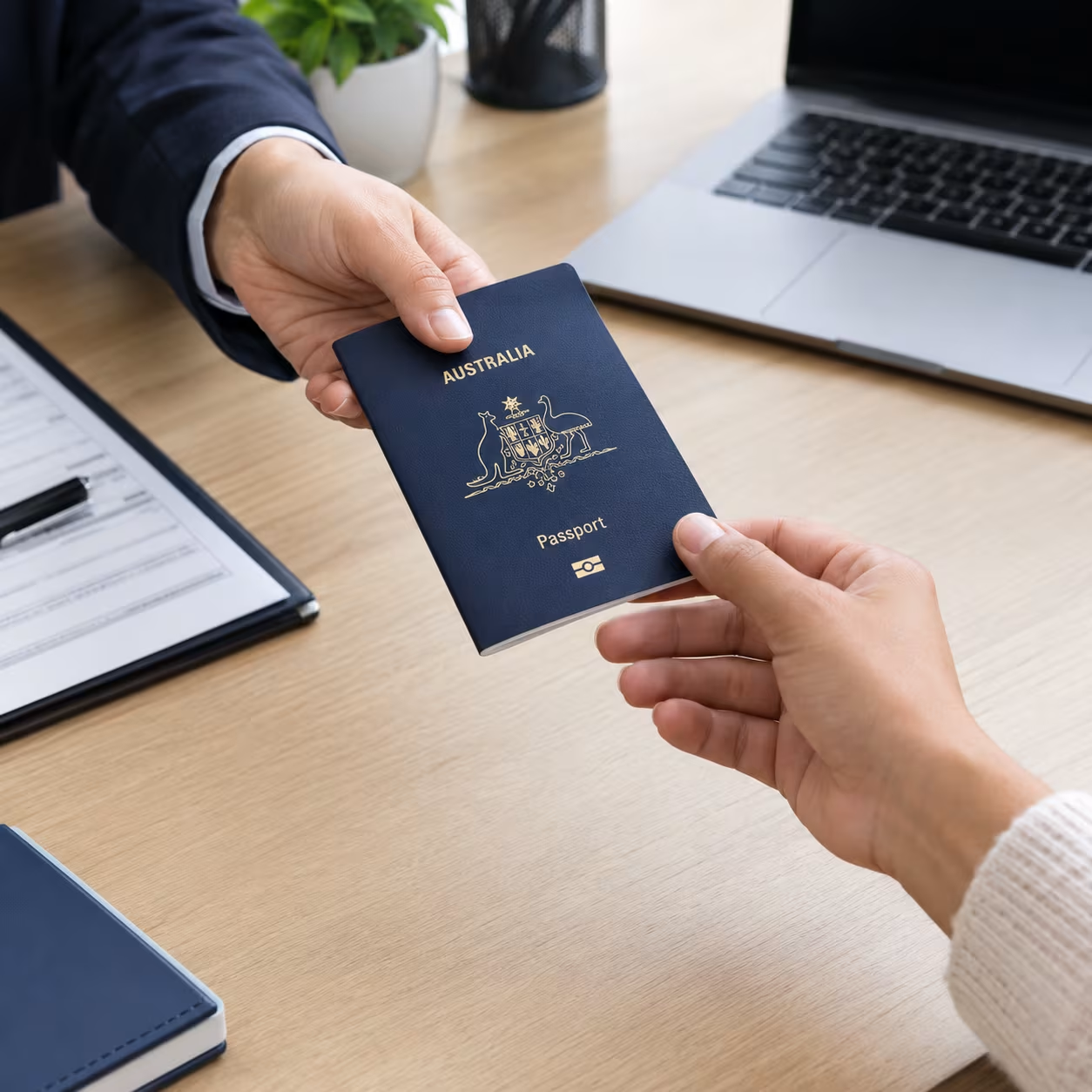
If you’re living overseas but engaged to an Australian citizen, permanent resident or eligible New Zealand citizen, the Prospective Marriage Visa (subclass 300) makes it possible for you to get married in Australia.
It's the only partner visa pathway designed specifically for couples who aren't yet married, and it comes with some requirements that don't apply to any other partner visa.
The subclass 300 visa allows you to enter Australia for the purpose of marrying your partner. Once you're in Australia and married, it becomes the starting point for your permanent residency journey.
But the application itself requires careful preparation, particularly around proving intent to marry, which is unlike anything else in Australia's partner visa programme.
This guide covers the full picture: eligibility requirements, the evidence Home Affairs expects to see, how to lodge your application, what the processing timeline looks like and what happens once your 300 visa is granted.
Key takeaways:
- The subclass 300 visa is for overseas-based fiancés planning to marry an Australian citizen, permanent resident or eligible New Zealand citizen.
- You must be outside Australia when you apply (however, if you are granted the visa instead of applying, you can be either inside or outside the country).
- A key requirement is proving intent to marry before the visa expires, which means having a registered marriage celebrant and a lodged Notice of Intention to Marry (NOIM) before you apply.
- The application fee is AUD $11,710 (as at 1 July 2026). You are generally not entitled to Medicare on a 300 visa, so you’ll most likely need private health insurance.
- Processing times vary significantly. Check the Home Affairs Global Visa Processing Times tool for current figures before planning your timeline.
- After marriage, you must apply for an onshore partner visa (subclass 820/801) before your 300 visa expires to remain in Australia legally.
What Is the Prospective Marriage Visa?
The Prospective Marriage Visa (subclass 300) is a temporary partner visa for overseas-based people who intend to marry an Australian citizen, permanent resident or eligible New Zealand citizen.
Unlike other partner visa pathways, which require you to already be in a married or de facto relationship, the 300 visa is specifically designed for couples who are engaged but not yet married.
Once granted, the 300 visa allows you to enter Australia and stay for nine to 15 months. Within that window, you must marry your partner. After the wedding, you can apply for an onshore partner visa (subclass 820 and 801), which puts you on the path to permanent residency.
The 300 visa gives you full work rights during your stay and you can study in Australia but must cover your own study costs as you will not receive any government support.
The visa does not give you access to Medicare, so Home Affairs recommends that you take out health insurance to cover any medical treatment while you’re in Australia.
Prospective Marriage Visa Eligibility Requirements
To be eligible for the subclass 300 visa, you must meet all of the following criteria at the time of application.
| Requirement |
What you need to show |
| Age |
18 years or older |
| Location |
Outside Australia at the time of application (unless you are granted the application rather than applying, in which case you can be inside Australia) |
| Sponsor |
An Australian citizen, permanent resident or eligible New Zealand citizen |
| Intent to marry |
Plan to marry your partner before the visa period ends (with a signed letter from a registered marriage celebrant and a lodged NOIM) |
| Health |
Be prepared to conduct health examinations after you submit your application |
| Character |
Provide police clearances from every country you've lived in for 12+ months in the past 10 years |
| Values statement |
Have a signed Australian Values Statement |
| Health insurance |
It is recommended that you have adequate private health insurance for your stay (you are not entitled to Medicare on a 300 visa) |
| No outstanding debts |
Have no debt owed to the Australian Government |
| Application fee |
Pay an application fee of AUD $11,710 (as at 1 July 2026) |
Matilda Tip: If you applied for the 300 visa before 26 November 2023, there's a regulatory change worth knowing about.
Under amendments to the Migration Regulations 1994, you may be granted this visa while in Australia if you were physically in the country at any point between 1 February 2020 and 25 November 2023 and you meet all other eligibility requirements. If this applies to your situation, seek specific advice before assuming you're covered.
The Intent-to-Marry Requirement: What You Need to Prove
The most distinctive feature of the 300 visa is the intent-to-marry requirement.
Home Affairs needs to be satisfied that you genuinely plan to marry your partner before your visa period ends, and that your relationship is genuine.
This means you can't apply for a 300 visa based on vague plans to "get married at some point". Concrete arrangements need to be in place before you lodge.
The Marriage Celebrant Letter
You must provide a signed and dated letter on letterhead from the registered marriage celebrant who will conduct your ceremony. The letter must include:
- The full date of your planned ceremony
- The venue where the ceremony will take place
- Confirmation that the celebrant is authorised to perform marriages under Australian law,
Matilda Tip: Don't leave the celebrant letter until the last minute. In Australia, a Notice of Intention to Marry (NOIM) must be lodged with your celebrant at least one month before the ceremony, and up to 18 months in advance.
Get this NOIM lodged early, as it provides a clear record of your wedding plans and demonstrates genuine intent. Your celebrant's signed letter confirming the booking is a core piece of evidence in your visa application.
Proving a Genuine Relationship
Home Affairs also assesses the authenticity of your relationship, even though you're not yet married. You'll need to provide evidence across a four-pillar framework used for all partner visas (covering the financial, household, social and commitment aspects of your relationship).
The evidence section below covers this in full. For an engaged couple who may not have lived together, the household and commitment pillars typically require the most attention.
Health and Character Requirements for the 300 Visa
Health Examination
You must complete a health examination at an approved panel clinic. After you submit your application to ImmiAccount, a medical questionnaire is generated automatically. From there, you can book your health examination.
Matilda Tip: When you complete your health examination, make sure your unique Health Appointment ID (HAP ID) is recorded on your medical form (the doctor at the panel clinic will know what this is). This links your examination results directly to your visa application in the Home Affairs system.
If your HAP ID isn't correctly recorded, your health results won't be associated with your application, which causes delays. Just confirm with the doctor that it’s included.
Character Requirements
Both you and your sponsor must meet Australia's character requirements under section 501 of the Migration Act 1958. This means police clearance certificates from every country either of you has lived in for 12 months or more during the past 10 years, plus an Australian National Police Check for the sponsor.
A conviction with a custodial sentence of 12 months or more (even if suspended) could result in your application being refused. Minor offences such as traffic infringements generally don't affect eligibility. What does matter is honesty.
Matilda Tip: Declare all criminal history, even minor offences. Home Affairs has access to your records and cross-references police clearances as part of its assessment.
Non-disclosure of anything (even an offence you don't think is relevant) is treated as dishonesty to the Commonwealth, which can result in a three-year ban on future visa applications.
If you have anything in your past you're unsure about, get advice before you lodge.
The Evidence Framework: Four Pillars of a Strong 300 Application
Australia's partner visa programme assesses your relationship across four pillars. For a 300 visa application, the challenge is that many engaged couples haven't lived together, so some evidence types that are easy for established de facto couples are harder to produce.
The table below maps each pillar to the kinds of evidence that work specifically for a prospective marriage application.
| Pillar |
What Home Affairs looks for |
Example evidence for a 300 application |
| Financial |
Shared finances and pooled expenses |
Joint bank account statements, evidence of sharing significant costs (i.e. joint assets, joint liabilities such as shared credit cards, money transfers, gifts), shared bills or subscriptions |
| Household |
Evidence of intent to establish a shared household |
Wedding venue booking, ring receipts, honeymoon plans, correspondence about future living arrangements |
| Social |
Recognition as a couple by others |
Photos together, joint invitations to events, statutory declarations from friends or family, evidence of meeting each other's families |
| Commitment |
The length, depth and seriousness of the relationship |
Relationship statement, communication history (messages, calls), travel history together, knowledge of each other's personal circumstances |
Not every type of evidence is relevant to every couple. Home Affairs looks at the overall picture. A strong application doesn't need to tick every box, but it does need to tell a coherent story about your relationship.
If your application has genuine gaps in one pillar (for example, if you haven't lived together and have limited household evidence), stronger evidence in other pillars can compensate.
One document that crosses all four pillars is your relationship statement. This is a written account of your relationship that includes how you met, how the relationship developed and why you're committed to each other.
A well-written, specific relationship statement is one of the most important pieces of evidence in any partner visa application. See our guide to writing a partner visa relationship statement for a full walkthrough.
How to Apply for the Prospective Marriage Visa: Step by Step
The 300 visa application is lodged online through ImmiAccount. The process runs across five key stages.
Step 1: Confirm Eligibility
Before you start gathering documents, confirm you meet all the eligibility criteria above, particularly that you are outside Australia at the time of application and that your sponsor holds Australian citizenship, permanent residency or an eligible New Zealand visa.
Also confirm your marriage plans are concrete enough to produce a celebrant letter and a lodged NOIM.
Step 2: Gather Your Documents
Organise your supporting documents across two streams: your own eligibility documents and your relationship evidence.
Your eligibility documents include:
- Passport and identity documents
- Police clearance certificates from every country where you've lived for 12+ months in the past 10 years
- Signed letter from your marriage celebrant confirming date, venue and NOIM lodgement.
Your relationship evidence should cover the four pillars above. Translate any non-English documents and provide both the original and a certified translation.
Step 3: Lodge through ImmiAccount
Once your documents are ready:
- Log in to your ImmiAccount or create a new account.
- Select 'New application' > 'Family'.
- Select 'Stage 1 – Partner or Prospective Marriage Visa'.
- Complete your application, attach all supporting documents and pay the application fee (AUD $11,710 as at 1 July 2026).
- Submit your application and note your Transaction Reference Number (TRN). Your sponsor will need this to complete their separate sponsorship application.
Matilda Tip: The sponsorship application is separate from your visa application. After you submit and receive your TRN, your sponsor must complete their own sponsorship application in ImmiAccount.
This is easy to miss, but both applications need to be lodged before Home Affairs can progress your case.
Step 4: Complete Your Health Examination
After lodging, you'll receive a medical questionnaire in ImmiAccount. Book your health examination at an approved panel clinic. Make sure your HAP ID is recorded correctly on your medical form so results link to your application automatically (the doctor will know what this is).
Step 5: Wait for a Decision
Home Affairs will review your application and may request additional information during processing. Once a decision is made, you'll receive written notification confirming your visa grant number, the start date of your visa and any conditions attached to it.
Prospective Marriage Visa Processing Times
Based on data current as at July 2026:
- 50% of applications are processed within 13 months
- 90% of applications are processed within 34 months
This means your wait from lodgement to decision could be anywhere from just over a year to more than three years. Processing times fluctuate with application volumes and staffing levels.
Before you plan your timeline, check the Home Affairs Global Visa Processing Times tool for figures current to the month you're applying.
A critical implication of these timelines: if processing takes more than18 months and you're waiting overseas, your planned wedding date may arrive before your visa does.
You cannot enter Australia on a 300 visa that hasn't been granted yet. You'd need another visa type to visit. Plan your wedding date with enough buffer to account for a realistic range of processing outcomes.
Matilda Tip: If you want to visit your partner in Australia while your 300 visa is being processed, you'll need a separate visitor visa (subclass 600). The fact that you've lodged a 300 application doesn't automatically give you the right to enter Australia in the meantime.
Apply for a Visitor Visa well in advance. Having your partner visa application reference number handy when applying helps.
What Happens After Your 300 Visa Is Granted?
Once your 300 visa is approved, you can travel to Australia. From the date of grant, you have nine to 15 months to marry your partner. The exact period is confirmed on your visa grant notice.
Getting Married
Your marriage must take place in Australia (or if you're marrying overseas, it must be a valid marriage under Australian law and recognised in Australia). Make sure your ceremony date is before your visa expires. If you don't marry within the visa period and your visa lapses, you'll need to leave Australia and reapply.
Applying for a partner visa after marriage
Once married, you need to apply for an onshore partner visa (subclass 820 and 801) to remain in Australia. This is the visa that takes you through to permanent residency.
Matilda Tip: If you and your spouse want to settle in Australia, apply for your subclass 820 partner visa after marriage and before your 300 visa expires.
Beyond the obvious legal reason (you must hold a valid visa to remain in Australia), there's a financial one: if you lodge your 820/801 application before your 300 expires, you'll pay a reduced application charge of AUD $1,955 (as at 1 July 2026).
The 820 visa is a two-stage process. The temporary stage (subclass 820) is typically granted first and gives you the right to stay and work in Australia while your application is assessed.
After at least two years on the 820, and if your relationship is ongoing, the permanent stage (subclass 801) is granted or you may be eligible for a double grant of the 801 at the same time as the 820 if you meet the requirements. Once you hold PR, the path to Australian citizenship opens up after four years of Australian residence, with at least one year as a permanent resident.
Prospective Marriage Visa vs Other Partner Visa Pathways
The subclass 300 is one of three main partner visa pathways in Australia. Which one is right for you depends on where you are, your relationship status and your circumstances.
| Feature |
Subclass 300 (Prospective Marriage) |
Subclass 309/100 (Offshore Partner) |
Subclass 820/801 (Onshore Partner) |
| Where you must be |
Outside Australia when applying |
Outside Australia when applying |
Inside Australia when applying |
| Relationship status |
Engaged (not yet married) |
Married or de facto (12+ months) |
Married or de facto (12+ months) |
| Visa validity |
9–15 months to marry, then must apply for partner visa |
Temporary until 100 PR stage |
Temporary until 801 PR stage |
| Work rights |
Yes, full work rights |
Yes, full work rights |
Yes, full work rights |
| Medicare |
No |
Yes |
Yes |
| Path to PR |
Apply for 820/801 after marriage |
Progresses to 100 (PR) |
Progresses to 801 (PR) |
| Application fee (main applicant) |
AUD $11,710 |
AUD $11,710 |
AUD $11,710 (reduced to AUD $1,955 for Subclass 300 holders) |
Where you must be: Outside Australia when applying
Relationship status: Engaged (not yet married)
Visa validity: 9–15 months to marry, then must apply for partner visa
Work rights: Yes, full work rights
Medicare: No
Path to PR: Apply for 820/801 after marriage
Application fee (main applicant): AUD $11,710
Where you must be: Outside Australia when applying
Relationship status: Married or de facto (12+ months)
Visa validity: Temporary until 100 PR stage
Work rights: Yes, full work rights
Medicare: Yes
Path to PR: Progresses to 100 (PR)
Application fee (main applicant): AUD $11,710
Where you must be: Inside Australia when applying
Relationship status: Married or de facto (12+ months)
Visa validity: Temporary until 801 PR stage
Work rights: Yes, full work rights
Medicare: Yes
Path to PR: Progresses to 801 (PR)
Application fee (main applicant): AUD $11,710 (reduced to AUD $1,955 for Subclass 300 holders)
If you're already married or have been in a de facto relationship for 12 months or more, the 300 visa is not the right pathway. You'd apply for an offshore partner visa (309/100) if you're overseas, or an onshore partner visa (820/801) if you're already in Australia.
Frequently Asked Questions
How much does the subclass 300 visa cost?
The application fee is AUD $11,710 for the main applicant (as at 1 July 2026). Dependent children can be added to the application for an additional charge. This is the government application fee only. If you're working with a migration agent or lawyer, their professional fees are separate. Note: The government fee is non-refundable even if your application is refused.
How long does it take to get a 300 visa?
Based on data published as at July 2026, 50% of applications are processed within 13 months and 90% within 34 months. Processing times can change. Check the Home Affairs Global Visa Processing Times tool for the most current figures before planning your wedding date.
Can I travel to Australia while my 300 visa is being processed?
Yes, but you'll need a separate visa to do so. A pending 300 application does not give you the right to enter Australia in the meantime. A subclass 600 Visitor Visa is the most common option.
Include your 300 application reference number and be transparent about your circumstances.
Can I add dependent children to my 300 visa application?
Yes. Dependent children can be included in your application as long as they are located outside Australia.
If you need to add a child after you've lodged, attach Form 1436 (Adding additional applicant after lodgement) and notify Home Affairs using the Partner Processing Enquiry Form.
What happens if I don't get married before my 300 visa expires?
If your 300 visa expires before you marry, you will need to leave Australia. You cannot remain in Australia on an expired visa. You would need to apply for another visa from outside Australia, which may mean reapplying for a 300 visa if you are still engaged and eligible, or a 309/100 visa once married.
This is why planning your wedding date carefully against realistic processing timelines is so important.
Is Medicare included with the 300 visa?
No. The subclass 300 visa does not include Medicare entitlement. It is recommended that you hold adequate private health insurance for the duration of your stay and are personally responsible for all medical costs.
Arrange your health insurance before you arrive in Australia, and confirm it covers the full range of medical treatment you're likely to need.
Can I apply for the 300 visa if I'm already in Australia?
No, you must be outside Australia when you apply. If your situation is unusual, get specific legal advice before lodging.
What if my sponsor has sponsored a partner visa before?
There are limits on how many times an Australian citizen, permanent resident or eligible New Zealand citizen can sponsor partner visas.
If your sponsor has previously sponsored a partner or prospective marriage visa, restrictions may apply, particularly if a previous application was granted within the last five years or if this would be the sponsor's third sponsorship.
Home Affairs assesses each case on its merits but this is an eligibility point worth checking before lodging.
Ready to Apply for Your Prospective Marriage Visa?
The subclass 300 visa is a well-defined pathway. The intent-to-marry requirement, the offshore lodgement condition and the variable processing times all make preparation and timing critical.
At Matilda, our lawyer-credentialled team has guided couples through every stage of the partner visa journey, from the first assessment through to the permanent visa grant. We have a Googe Review rating of 4.9 stars from 90+ reviews and a "no visa, no fee" guarantee on professional fees.
For applicants, check your eligibility and book a free consultation with Matilda to get a personalised plan for your prospective marriage visa application.
For Australian employers supporting staff on partner visa pathways, talk to us about how we can support your team.
If you’re living overseas but engaged to an Australian citizen, permanent resident or eligible New Zealand citizen, the Prospective Marriage Visa (subclass 300) makes it possible for you to get married in Australia.
It's the only partner visa pathway designed specifically for couples who aren't yet married, and it comes with some requirements that don't apply to any other partner visa.
The subclass 300 visa allows you to enter Australia for the purpose of marrying your partner. Once you're in Australia and married, it becomes the starting point for your permanent residency journey.
But the application itself requires careful preparation, particularly around proving intent to marry, which is unlike anything else in Australia's partner visa programme.
This guide covers the full picture: eligibility requirements, the evidence Home Affairs expects to see, how to lodge your application, what the processing timeline looks like and what happens once your 300 visa is granted.
Key takeaways:
- The subclass 300 visa is for overseas-based fiancés planning to marry an Australian citizen, permanent resident or eligible New Zealand citizen.
- You must be outside Australia when you apply (however, if you are granted the visa instead of applying, you can be either inside or outside the country).
- A key requirement is proving intent to marry before the visa expires, which means having a registered marriage celebrant and a lodged Notice of Intention to Marry (NOIM) before you apply.
- The application fee is AUD $11,710 (as at 1 July 2026). You are generally not entitled to Medicare on a 300 visa, so you’ll most likely need private health insurance.
- Processing times vary significantly. Check the Home Affairs Global Visa Processing Times tool for current figures before planning your timeline.
- After marriage, you must apply for an onshore partner visa (subclass 820/801) before your 300 visa expires to remain in Australia legally.
What Is the Prospective Marriage Visa?
The Prospective Marriage Visa (subclass 300) is a temporary partner visa for overseas-based people who intend to marry an Australian citizen, permanent resident or eligible New Zealand citizen.
Unlike other partner visa pathways, which require you to already be in a married or de facto relationship, the 300 visa is specifically designed for couples who are engaged but not yet married.
Once granted, the 300 visa allows you to enter Australia and stay for nine to 15 months. Within that window, you must marry your partner. After the wedding, you can apply for an onshore partner visa (subclass 820 and 801), which puts you on the path to permanent residency.
The 300 visa gives you full work rights during your stay and you can study in Australia but must cover your own study costs as you will not receive any government support.
The visa does not give you access to Medicare, so Home Affairs recommends that you take out health insurance to cover any medical treatment while you’re in Australia.
Prospective Marriage Visa Eligibility Requirements
To be eligible for the subclass 300 visa, you must meet all of the following criteria at the time of application.
| Requirement |
What you need to show |
| Age |
18 years or older |
| Location |
Outside Australia at the time of application (unless you are granted the application rather than applying, in which case you can be inside Australia) |
| Sponsor |
An Australian citizen, permanent resident or eligible New Zealand citizen |
| Intent to marry |
Plan to marry your partner before the visa period ends (with a signed letter from a registered marriage celebrant and a lodged NOIM) |
| Health |
Be prepared to conduct health examinations after you submit your application |
| Character |
Provide police clearances from every country you've lived in for 12+ months in the past 10 years |
| Values statement |
Have a signed Australian Values Statement |
| Health insurance |
It is recommended that you have adequate private health insurance for your stay (you are not entitled to Medicare on a 300 visa) |
| No outstanding debts |
Have no debt owed to the Australian Government |
| Application fee |
Pay an application fee of AUD $11,710 (as at 1 July 2026) |
Matilda Tip: If you applied for the 300 visa before 26 November 2023, there's a regulatory change worth knowing about.
Under amendments to the Migration Regulations 1994, you may be granted this visa while in Australia if you were physically in the country at any point between 1 February 2020 and 25 November 2023 and you meet all other eligibility requirements. If this applies to your situation, seek specific advice before assuming you're covered.
The Intent-to-Marry Requirement: What You Need to Prove
The most distinctive feature of the 300 visa is the intent-to-marry requirement.
Home Affairs needs to be satisfied that you genuinely plan to marry your partner before your visa period ends, and that your relationship is genuine.
This means you can't apply for a 300 visa based on vague plans to "get married at some point". Concrete arrangements need to be in place before you lodge.
The Marriage Celebrant Letter
You must provide a signed and dated letter on letterhead from the registered marriage celebrant who will conduct your ceremony. The letter must include:
- The full date of your planned ceremony
- The venue where the ceremony will take place
- Confirmation that the celebrant is authorised to perform marriages under Australian law,
Matilda Tip: Don't leave the celebrant letter until the last minute. In Australia, a Notice of Intention to Marry (NOIM) must be lodged with your celebrant at least one month before the ceremony, and up to 18 months in advance.
Get this NOIM lodged early, as it provides a clear record of your wedding plans and demonstrates genuine intent. Your celebrant's signed letter confirming the booking is a core piece of evidence in your visa application.
Proving a Genuine Relationship
Home Affairs also assesses the authenticity of your relationship, even though you're not yet married. You'll need to provide evidence across a four-pillar framework used for all partner visas (covering the financial, household, social and commitment aspects of your relationship).
The evidence section below covers this in full. For an engaged couple who may not have lived together, the household and commitment pillars typically require the most attention.
Health and Character Requirements for the 300 Visa
Health Examination
You must complete a health examination at an approved panel clinic. After you submit your application to ImmiAccount, a medical questionnaire is generated automatically. From there, you can book your health examination.
Matilda Tip: When you complete your health examination, make sure your unique Health Appointment ID (HAP ID) is recorded on your medical form (the doctor at the panel clinic will know what this is). This links your examination results directly to your visa application in the Home Affairs system.
If your HAP ID isn't correctly recorded, your health results won't be associated with your application, which causes delays. Just confirm with the doctor that it’s included.
Character Requirements
Both you and your sponsor must meet Australia's character requirements under section 501 of the Migration Act 1958. This means police clearance certificates from every country either of you has lived in for 12 months or more during the past 10 years, plus an Australian National Police Check for the sponsor.
A conviction with a custodial sentence of 12 months or more (even if suspended) could result in your application being refused. Minor offences such as traffic infringements generally don't affect eligibility. What does matter is honesty.
Matilda Tip: Declare all criminal history, even minor offences. Home Affairs has access to your records and cross-references police clearances as part of its assessment.
Non-disclosure of anything (even an offence you don't think is relevant) is treated as dishonesty to the Commonwealth, which can result in a three-year ban on future visa applications.
If you have anything in your past you're unsure about, get advice before you lodge.
The Evidence Framework: Four Pillars of a Strong 300 Application
Australia's partner visa programme assesses your relationship across four pillars. For a 300 visa application, the challenge is that many engaged couples haven't lived together, so some evidence types that are easy for established de facto couples are harder to produce.
The table below maps each pillar to the kinds of evidence that work specifically for a prospective marriage application.
| Pillar |
What Home Affairs looks for |
Example evidence for a 300 application |
| Financial |
Shared finances and pooled expenses |
Joint bank account statements, evidence of sharing significant costs (i.e. joint assets, joint liabilities such as shared credit cards, money transfers, gifts), shared bills or subscriptions |
| Household |
Evidence of intent to establish a shared household |
Wedding venue booking, ring receipts, honeymoon plans, correspondence about future living arrangements |
| Social |
Recognition as a couple by others |
Photos together, joint invitations to events, statutory declarations from friends or family, evidence of meeting each other's families |
| Commitment |
The length, depth and seriousness of the relationship |
Relationship statement, communication history (messages, calls), travel history together, knowledge of each other's personal circumstances |
Not every type of evidence is relevant to every couple. Home Affairs looks at the overall picture. A strong application doesn't need to tick every box, but it does need to tell a coherent story about your relationship.
If your application has genuine gaps in one pillar (for example, if you haven't lived together and have limited household evidence), stronger evidence in other pillars can compensate.
One document that crosses all four pillars is your relationship statement. This is a written account of your relationship that includes how you met, how the relationship developed and why you're committed to each other.
A well-written, specific relationship statement is one of the most important pieces of evidence in any partner visa application. See our guide to writing a partner visa relationship statement for a full walkthrough.
How to Apply for the Prospective Marriage Visa: Step by Step
The 300 visa application is lodged online through ImmiAccount. The process runs across five key stages.
Step 1: Confirm Eligibility
Before you start gathering documents, confirm you meet all the eligibility criteria above, particularly that you are outside Australia at the time of application and that your sponsor holds Australian citizenship, permanent residency or an eligible New Zealand visa.
Also confirm your marriage plans are concrete enough to produce a celebrant letter and a lodged NOIM.
Step 2: Gather Your Documents
Organise your supporting documents across two streams: your own eligibility documents and your relationship evidence.
Your eligibility documents include:
- Passport and identity documents
- Police clearance certificates from every country where you've lived for 12+ months in the past 10 years
- Signed letter from your marriage celebrant confirming date, venue and NOIM lodgement.
Your relationship evidence should cover the four pillars above. Translate any non-English documents and provide both the original and a certified translation.
Step 3: Lodge through ImmiAccount
Once your documents are ready:
- Log in to your ImmiAccount or create a new account.
- Select 'New application' > 'Family'.
- Select 'Stage 1 – Partner or Prospective Marriage Visa'.
- Complete your application, attach all supporting documents and pay the application fee (AUD $11,710 as at 1 July 2026).
- Submit your application and note your Transaction Reference Number (TRN). Your sponsor will need this to complete their separate sponsorship application.
Matilda Tip: The sponsorship application is separate from your visa application. After you submit and receive your TRN, your sponsor must complete their own sponsorship application in ImmiAccount.
This is easy to miss, but both applications need to be lodged before Home Affairs can progress your case.
Step 4: Complete Your Health Examination
After lodging, you'll receive a medical questionnaire in ImmiAccount. Book your health examination at an approved panel clinic. Make sure your HAP ID is recorded correctly on your medical form so results link to your application automatically (the doctor will know what this is).
Step 5: Wait for a Decision
Home Affairs will review your application and may request additional information during processing. Once a decision is made, you'll receive written notification confirming your visa grant number, the start date of your visa and any conditions attached to it.
Prospective Marriage Visa Processing Times
Based on data current as at July 2026:
- 50% of applications are processed within 13 months
- 90% of applications are processed within 34 months
This means your wait from lodgement to decision could be anywhere from just over a year to more than three years. Processing times fluctuate with application volumes and staffing levels.
Before you plan your timeline, check the Home Affairs Global Visa Processing Times tool for figures current to the month you're applying.
A critical implication of these timelines: if processing takes more than18 months and you're waiting overseas, your planned wedding date may arrive before your visa does.
You cannot enter Australia on a 300 visa that hasn't been granted yet. You'd need another visa type to visit. Plan your wedding date with enough buffer to account for a realistic range of processing outcomes.
Matilda Tip: If you want to visit your partner in Australia while your 300 visa is being processed, you'll need a separate visitor visa (subclass 600). The fact that you've lodged a 300 application doesn't automatically give you the right to enter Australia in the meantime.
Apply for a Visitor Visa well in advance. Having your partner visa application reference number handy when applying helps.
What Happens After Your 300 Visa Is Granted?
Once your 300 visa is approved, you can travel to Australia. From the date of grant, you have nine to 15 months to marry your partner. The exact period is confirmed on your visa grant notice.
Getting Married
Your marriage must take place in Australia (or if you're marrying overseas, it must be a valid marriage under Australian law and recognised in Australia). Make sure your ceremony date is before your visa expires. If you don't marry within the visa period and your visa lapses, you'll need to leave Australia and reapply.
Applying for a partner visa after marriage
Once married, you need to apply for an onshore partner visa (subclass 820 and 801) to remain in Australia. This is the visa that takes you through to permanent residency.
Matilda Tip: If you and your spouse want to settle in Australia, apply for your subclass 820 partner visa after marriage and before your 300 visa expires.
Beyond the obvious legal reason (you must hold a valid visa to remain in Australia), there's a financial one: if you lodge your 820/801 application before your 300 expires, you'll pay a reduced application charge of AUD $1,955 (as at 1 July 2026).
The 820 visa is a two-stage process. The temporary stage (subclass 820) is typically granted first and gives you the right to stay and work in Australia while your application is assessed.
After at least two years on the 820, and if your relationship is ongoing, the permanent stage (subclass 801) is granted or you may be eligible for a double grant of the 801 at the same time as the 820 if you meet the requirements. Once you hold PR, the path to Australian citizenship opens up after four years of Australian residence, with at least one year as a permanent resident.
Prospective Marriage Visa vs Other Partner Visa Pathways
The subclass 300 is one of three main partner visa pathways in Australia. Which one is right for you depends on where you are, your relationship status and your circumstances.
| Feature |
Subclass 300 (Prospective Marriage) |
Subclass 309/100 (Offshore Partner) |
Subclass 820/801 (Onshore Partner) |
| Where you must be |
Outside Australia when applying |
Outside Australia when applying |
Inside Australia when applying |
| Relationship status |
Engaged (not yet married) |
Married or de facto (12+ months) |
Married or de facto (12+ months) |
| Visa validity |
9–15 months to marry, then must apply for partner visa |
Temporary until 100 PR stage |
Temporary until 801 PR stage |
| Work rights |
Yes, full work rights |
Yes, full work rights |
Yes, full work rights |
| Medicare |
No |
Yes |
Yes |
| Path to PR |
Apply for 820/801 after marriage |
Progresses to 100 (PR) |
Progresses to 801 (PR) |
| Application fee (main applicant) |
AUD $11,710 |
AUD $11,710 |
AUD $11,710 (reduced to AUD $1,955 for Subclass 300 holders) |
Where you must be: Outside Australia when applying
Relationship status: Engaged (not yet married)
Visa validity: 9–15 months to marry, then must apply for partner visa
Work rights: Yes, full work rights
Medicare: No
Path to PR: Apply for 820/801 after marriage
Application fee (main applicant): AUD $11,710
Where you must be: Outside Australia when applying
Relationship status: Married or de facto (12+ months)
Visa validity: Temporary until 100 PR stage
Work rights: Yes, full work rights
Medicare: Yes
Path to PR: Progresses to 100 (PR)
Application fee (main applicant): AUD $11,710
Where you must be: Inside Australia when applying
Relationship status: Married or de facto (12+ months)
Visa validity: Temporary until 801 PR stage
Work rights: Yes, full work rights
Medicare: Yes
Path to PR: Progresses to 801 (PR)
Application fee (main applicant): AUD $11,710 (reduced to AUD $1,955 for Subclass 300 holders)
If you're already married or have been in a de facto relationship for 12 months or more, the 300 visa is not the right pathway. You'd apply for an offshore partner visa (309/100) if you're overseas, or an onshore partner visa (820/801) if you're already in Australia.
Frequently Asked Questions
How much does the subclass 300 visa cost?
The application fee is AUD $11,710 for the main applicant (as at 1 July 2026). Dependent children can be added to the application for an additional charge. This is the government application fee only. If you're working with a migration agent or lawyer, their professional fees are separate. Note: The government fee is non-refundable even if your application is refused.
How long does it take to get a 300 visa?
Based on data published as at July 2026, 50% of applications are processed within 13 months and 90% within 34 months. Processing times can change. Check the Home Affairs Global Visa Processing Times tool for the most current figures before planning your wedding date.
Can I travel to Australia while my 300 visa is being processed?
Yes, but you'll need a separate visa to do so. A pending 300 application does not give you the right to enter Australia in the meantime. A subclass 600 Visitor Visa is the most common option.
Include your 300 application reference number and be transparent about your circumstances.
Can I add dependent children to my 300 visa application?
Yes. Dependent children can be included in your application as long as they are located outside Australia.
If you need to add a child after you've lodged, attach Form 1436 (Adding additional applicant after lodgement) and notify Home Affairs using the Partner Processing Enquiry Form.
What happens if I don't get married before my 300 visa expires?
If your 300 visa expires before you marry, you will need to leave Australia. You cannot remain in Australia on an expired visa. You would need to apply for another visa from outside Australia, which may mean reapplying for a 300 visa if you are still engaged and eligible, or a 309/100 visa once married.
This is why planning your wedding date carefully against realistic processing timelines is so important.
Is Medicare included with the 300 visa?
No. The subclass 300 visa does not include Medicare entitlement. It is recommended that you hold adequate private health insurance for the duration of your stay and are personally responsible for all medical costs.
Arrange your health insurance before you arrive in Australia, and confirm it covers the full range of medical treatment you're likely to need.
Can I apply for the 300 visa if I'm already in Australia?
No, you must be outside Australia when you apply. If your situation is unusual, get specific legal advice before lodging.
What if my sponsor has sponsored a partner visa before?
There are limits on how many times an Australian citizen, permanent resident or eligible New Zealand citizen can sponsor partner visas.
If your sponsor has previously sponsored a partner or prospective marriage visa, restrictions may apply, particularly if a previous application was granted within the last five years or if this would be the sponsor's third sponsorship.
Home Affairs assesses each case on its merits but this is an eligibility point worth checking before lodging.
Ready to Apply for Your Prospective Marriage Visa?
The subclass 300 visa is a well-defined pathway. The intent-to-marry requirement, the offshore lodgement condition and the variable processing times all make preparation and timing critical.
At Matilda, our lawyer-credentialled team has guided couples through every stage of the partner visa journey, from the first assessment through to the permanent visa grant. We have a Googe Review rating of 4.9 stars from 90+ reviews and a "no visa, no fee" guarantee on professional fees.
For applicants, check your eligibility and book a free consultation with Matilda to get a personalised plan for your prospective marriage visa application.
For Australian employers supporting staff on partner visa pathways, talk to us about how we can support your team.
Niamh Mooney, LPN 5515274
Niamh is a qualified lawyer and has spent the last four years running businesses. She’s a first generation migrant from Ireland and has experienced the benefits of Australia’s skilled migration program first hand.
Employer sponsored visas
Which visas do you process?
Our team is able to support clients with a variety of visa applications including:
Partner visa: Subclass 820 and 801 (onshore) or 309 and 100 (offshore)
Student visa: Subclass 500
Temporary graduate visa: Subclass 485
Employer sponsored visa: Subclass TSS482
Skilled independent visa: Subclass 189
Business innovation and investment visa: Subclass 188
We’re also able to assist with applications for Australian Citizenship.
Lorem ipsum dolor sit amet, consectetur adipiscing elit. Suspendisse varius enim in eros elementum tristique. Duis cursus, mi quis viverra ornare, eros dolor interdum nulla, ut commodo diam libero vitae erat. Aenean faucibus nibh et justo cursus id rutrum lorem imperdiet. Nunc ut sem vitae risus tristique posuere.