Partner Visa Evidence: Photos, Communication and Third-Party Statements
Evidence guide for your 820 or 309 partner visa. Covers photo albums, communication records, Form 888 statements and what not to include.

Whether you're applying for an 820 partner visa (onshore) or a 309 partner visa (offshore), you might be wondering how much evidence you actually need in terms of photos, communication and witness statements. These areas are often overlooked, but it may surprise you to learn that more isn’t always better.
The Department of Home Affairs wants curated, well-organised evidence that clearly demonstrates a genuine, continuing relationship. Submitting a mountain of irrelevant documents can work against you, as it makes your application harder to assess and can bury the strongest proof of your relationship.
At Matilda, we can help you create professionally compiled evidence albums and provide personalised checklists tailored to your relationship. Whether you work with us or go it alone, this guide will help you get it right.
The evidence requirements for 820 and 309 partner visas are pretty much the same. The difference is where you lodge from, not what you need to prove.
This guide focuses on the evidence types that trip up most applicants: photo albums, communication records and third-party statements. We'll show you exactly what to include, how to present it and what to leave out.
The Four Pillars: A Quick Overview
The Department of Home Affairs assesses your partner visa application against four key areas: financial aspects, nature of household, social aspects and nature of commitment. Your evidence needs to cover all four.
For a detailed breakdown of which documents to collect for each pillar, see our step-by-step guide to applying for a partner visa. For particular guidance on your relationship statement, see our guide on how to write a compelling statement.
This guide assumes you've gathered your core documents. Now let's focus on getting the presentation right.
Photo Evidence: Quality Over Quantity
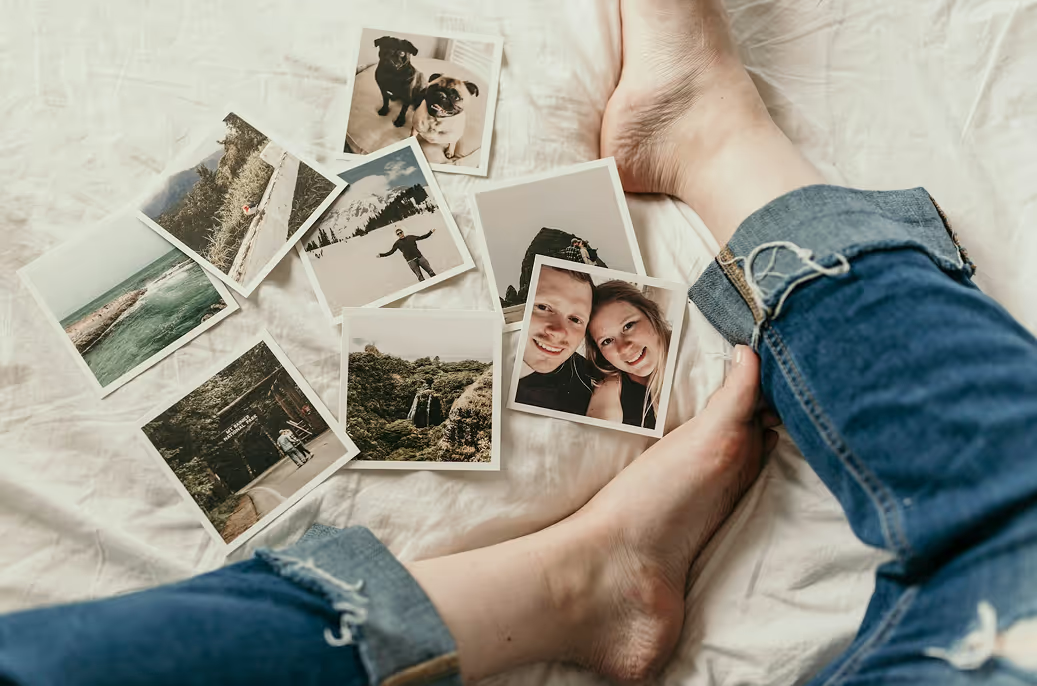
Photos are some of the most powerful evidence you can provide for your 820 or 309 partner visa, but only if they're curated properly.
Aim for a total of 50-100 photos across your entire application. More than this risks overwhelming the case officer and diluting your strongest evidence.
Avoid hundreds of similar photos from one event, low-quality or blurry images and large gaps in your timeline (such as plenty of photos from 2022 but nothing from 2023).
What Makes Strong Photo Evidence
Your photos should:
- Span the entire relationship, from when you met until now. Avoid large gaps in dates or clusters of photos from only one time period. Home Affairs wants to see continuity.
- Show varied contexts such as holidays, family events, everyday life, celebrations and quiet moments at home. A mix demonstrates that your relationship exists across different situations.
- Include other people, not just the two of you. Photos with family members, friends and colleagues show your wider social network recognises your relationship.
- Be captioned with dates, locations and the names of others in the photos. This helps the case officer follow your relationship timeline.
- Be chronological, with photos organised in date order so they tell the story of your relationship's development.
Communication Evidence: Messages and Call Records
Communication evidence shows your relationship continued during periods spent apart. This is especially important if you’re a 309 partner visa applicant, as you might have extended periods of long-distance communication before and during the application process.
But it's also relevant for 820 partner visa applicants who spent time apart before moving in together due to work or travel.
What to Include
- Screenshots of meaningful conversations (not every message)
- Call logs showing frequency and duration
- Video call records
- Letters or cards
Focus on messages that show the development of your relationship, emotional connection and shared planning. You don't need to include every "good morning" text. Go with conversations demonstrating substance.
For 309 Applicants
If you and your partner have been living in different countries, communication evidence is essential. Include records that show regular, ongoing contact throughout your time apart (such as video calls, messaging apps and emails). This demonstrates your relationship continued despite the distance.
If Early Communication Is Lost
Many couples don't have their earliest messages. Platforms change, phones get replaced, accounts get deleted. If this is the case for you:
- Provide a statutory declaration explaining what happened
- Include whatever records you do have, even if they start later
- Use other evidence to cover the early period (photos, travel bookings, witness statements that reference early communication).
Don't fabricate or recreate lost records. Home Affairs would rather see an honest explanation than suspicious "recovered" evidence.
Witness Statements (Form 888)
Statutory declarations from friends and family, known as Form 888 statements, provide independent verification of your relationship from people who know you as a couple.
Who Should Write Them
Choose people who have known you as a couple for a reasonable period and can speak about specific experiences and observations. They do not need to be Australian citizens or permanent residents; they just need to be at least 18 years of age and know both you and your partner.
Aim for 2-4 statements from a mix of people, such as one family member from each side and one or two friends.
What They Should Include
The most common problem with Form 888 statements is that they're too generic and short. Witnesses should use all the space allocated to provide specific accounts of your relationship as seen from their perspective.
Instead of writing: "I have known John and Sarah for two years. They are a genuine couple and live together."
They should write something like: "I first met John and Sarah at a barbecue at their home in March 2023. Sarah introduced John as her partner and they were clearly comfortable together, finishing each other's sentences and sharing cooking duties. Since then, I've seen them at several family events including Christmas 2023 at Sarah's parents' house, where John helped Sarah's father set up the new television and joined in the family traditions. They recently told me they're saving for a house deposit together."
Specific anecdotes, dates and observations are far more persuasive than generic statements.
Matilda Tip: Ensure the dates and events in witness statements align with the ones in your own evidence. Sometimes misaligned dates and misremembered accounts of events can create confusion.
Evidence to Leave Out of Your Application
Including irrelevant or problematic documents can hurt your 820 or 309 partner visa application. Avoid:
- Duplicate documents, such as the same bank statement twice or multiple copies of your lease.
- Irrelevant material, like a receipt for groceries. Focus on meaningful evidence.
- Documents with unexplained inconsistencies, which can raise red flags. If your address differs across documents, explain why.
- Excessive volume that can cause confusion and take longer to process. More evidence isn't better evidence. Curate ruthlessly.
If You're Missing a Required Document
Don't immediately substitute a missing document with secondary evidence. First, exhaust all options for obtaining the original document (contact the issuing authority, check old emails or request duplicates).
Only look at which combination of secondary documents could plug the gap once you've confirmed the primary document genuinely isn't available.
Frequently Asked Questions
How many photos should I include in my 820 or 309 partner visa application?
Aim for a total of 50-100 photos across your entire application. Quality and variety matter more than volume. Make sure they span the full length of your relationship, with no large gaps.
Is the evidence different for 820 and 309 partner visas?
The core requirements are the same. The main difference is that 309 applicants (offshore) often have more communication evidence to show ongoing contact during time apart, while 820 applicants (onshore) typically have more shared household evidence.
What if we've lost our early messages?
Provide a statutory declaration explaining what happened, include whatever records you do have starting from a later date and use other evidence (photos, travel bookings, witness statements) to cover the early period.
Do Form 888 witnesses need to be Australian citizens?
No, this is not a requirement. Witnesses must know you and your partner, as well as the history of your relationship, and be at least 18 years old but they do not need to be Australian citizens.
When they complete Form 888, they must provide documentation with evidence of their name and age (such as a copy of their birth certificate or passport). If they are Australian citizens or permanent residents, it’s a good idea to provide a copy of their Australian passport or passport containing a permanent visa.
Should photos include other people or just us as a couple?
Both. Include photos of just the two of you, but also photos with family, friends and colleagues. This shows your wider social network recognises your relationship.
Partner Visa Evidence Checklist: Photos, Communication, Witness Statements
Your 820 or 309 partner visa application doesn't need hundreds of documents. It needs the right ones, presented well.
- 50-100 curated photos spanning your full relationship
- Photos showing varied contexts and your wider social network
- All photos captioned with dates, locations and names
- Communication evidence (especially important for 309 applicants)
- Explanation for any lost early records
- 2-4 detailed Form 888 statements with specific anecdotes
- No duplicates, irrelevant documents or unexplained inconsistencies
For document checklists covering all four pillars, see our step-by-step application guide.
Need help compiling your evidence?
Get started with Matilda. Our platform creates professionally compiled evidence albums and provides personalised checklists tailored to your relationship, eliminating the guesswork and ensuring nothing critical is missed.
Employer sponsored visas
Our team is able to support clients with a variety of visa applications including:
Partner visa: Subclass 820 and 801 (onshore) or 309 and 100 (offshore)
Student visa: Subclass 500
Temporary graduate visa: Subclass 485
Employer sponsored visa: Subclass TSS482
Skilled independent visa: Subclass 189
Business innovation and investment visa: Subclass 188
We’re also able to assist with applications for Australian Citizenship.
Lorem ipsum dolor sit amet, consectetur adipiscing elit. Suspendisse varius enim in eros elementum tristique. Duis cursus, mi quis viverra ornare, eros dolor interdum nulla, ut commodo diam libero vitae erat. Aenean faucibus nibh et justo cursus id rutrum lorem imperdiet. Nunc ut sem vitae risus tristique posuere.